
SEO for Hospitals · Multi-Speciality
A hospital is not one business. It is forty.
Every department competes in a different search market, every consultant is a searchable entity in their own right, and every locality you draw patients from behaves differently. Hospital SEO fails when it is treated as one website with one keyword list. It works when it is treated as a coverage problem — departments multiplied by doctors multiplied by catchment — and built in the order that pays.
Dept × Doctor × Locality
the coverage matrix
YMYL
the content standard enforced
24/7
emergency-intent visibility
Per-consultant
entity building
How patients actually arrive at a hospital
Three routes, and they need entirely different pages. Most hospital sites build only the third.
| The moment | What they search | What wins it |
|---|---|---|
| Emergency — decided in minutes, usually by a relative | "emergency hospital near me", "24 hour hospital [area]" | Map presence, accurate hours, a phone number that works |
| Speciality — referred or self-directed, deciding over days | "best cardiology hospital [city]", "knee replacement cost" | Department pages with named consultants and honest cost ranges |
| Consultant — they have a doctor’s name and are checking them | "Dr [name] [speciality]", "[hospital] reviews" | A complete, verifiable profile per consultant |
Why large hospitals underperform small clinics in search
Size works against you here. A single clinic optimises one page well; a hospital has four hundred pages, most of them thin, and no clear owner for any of them.
| What is holding you back | What we do about it |
|---|---|
| Department pages that list services and nothing else | Each department rebuilt around conditions treated, procedures, consultants and costs |
| Consultants with no individual presence | A profile per doctor with credentials, registrations and Physician schema |
| One Google profile for a multi-building campus | Correct primary profile plus departments and locations handled properly |
| No emergency-intent visibility | Hours, emergency signals and after-hours paths made unambiguous |
| Costs hidden entirely | Published ranges for the procedures patients search by price |
| Invisible in AI health answers | Physician-attributed content and consistent entity signals across platforms |
The local system underneath this produced +520% local visibility and map pack top three in four months for a Delhi practice. Hospitals add scale and a governance problem, not a different method.
See which departments are invisible
We map your departments against what patients in your catchment actually search, show which consultants have no findable presence, and check what AI assistants answer for your specialities. Free, in 48 hours.
What we do
The programme, scoped to your sector.
- Coverage mapping: every department scored against real search demand in your catchment, then sequenced by revenue rather than by who asks loudest
- Consultant entities: a proper profile per doctor — credentials, registrations, languages, timings — marked up so search engines and AI assistants can resolve them
- Department depth: conditions, procedures, what to expect, recovery and honest cost ranges, each under a named clinical reviewer
- Local and emergency: profile accuracy across campuses, emergency-intent coverage, and review programmes that respect patient confidentiality
- Governance: a publishing workflow your medical team can actually sustain, because a hospital content programme dies without one
Build in revenue order, not organisational order
The instinct in every hospital is to build all departments at once, or to start with whichever head of department pushes hardest. Both produce four hundred thin pages and no rankings.
We score departments on three things: search demand in your actual catchment, contribution to hospital revenue, and how contested the term already is. Cardiology and orthopaedics usually top the list; some departments turn out not to be worth building for at all, and we say so. The first three departments get real depth, then the next three, and the consultant profiles run in parallel because they are cheap and they compound.
Where we would start, and in what order
Hospital programmes fail on sequencing more than on execution. This is the order we run, and the reasoning behind it.
- Weeks 1–4 — profiles and consultants. Campus Google profiles corrected and de-duplicated, then consultant profiles built. These are cheap, they rank for name searches almost immediately, and they carry the credential signals every department page will later depend on.
- Weeks 4–8 — the first three departments. Scored on catchment demand, revenue contribution and competition, then built properly. Not all forty. The scoring exercise usually surprises people, and it is where we earn our keep.
- Weeks 8–12 — emergency intent and governance. Hours, emergency signals and after-hours paths made unambiguous, and a publishing workflow your medical team can sustain. Hospital content programmes die from lack of governance, not lack of ideas.
What it costs
Hospital programmes start at ₹50,000 / $999 per month for a single campus with a phased department build, and scale from there with the number of consultants and locations. Larger groups typically need Scale at ₹85,000 / $1,699. Full tiers on the pricing page. Against the value of a single additional surgical admission per month, this is not usually a difficult case to make.
Who this works for — and who should not buy it
We would rather scope you out than take money for something that will not work.
Strong fit
- You have consultants willing to be visible and reviewed
- Someone can own clinical sign-off on content
- You draw from a definable catchment
- You want to reduce dependence on aggregator platforms
Poor fit
- No one internally can approve clinical content — the programme will stall
- You expect all departments built simultaneously
- You want outcome or success-rate claims published
- Your beds are already full
Questions
From businesses considering this.
Where do we start with forty departments?
With three. Scored on catchment demand, revenue contribution and competition. Everything else waits, and some departments never justify the investment — we will tell you which.
Should consultants have their own pages?
Yes, and it is often the highest-return work in a hospital programme. Patients search for people. A consultant profile is cheap to build, ranks for name searches, and carries the E-E-A-T signals your department pages need.
How do we manage Google profiles across a campus?
Carefully. Multiple buildings, departments and entrances create duplicate and conflicting listings constantly. Getting the primary profile right and the rest correctly structured is unglamorous and it moves the needle more than most content.
Do we have to publish prices?
For procedures patients search by cost — joint replacement, cardiac procedures, deliveries — ranges help considerably. Your competitors mostly hide them, which is the opportunity. We will not push you further than you are comfortable.
Who writes the medical content?
We draft from your department input and published sources; your clinicians review and it publishes under a named reviewer. No clinical claim goes live unreviewed.
How long before this shows in admissions?
Consultant profiles and local fixes move in 2–4 months. Department depth compounds over 6–12. Hospital programmes are slower to start and harder to displace once established.
Your cardiology department is competing with a three-doctor clinic.
The free audit maps your departments against real catchment demand and shows which consultants have no findable presence at all.
Google reviews
What clients say on Google.
From the blog
Notes from the front of search.
What we are seeing in client accounts, and what changed in Google and the AI engines this month.

Google August 2026 Spam Update: What Changed and What to Do Now
Google’s third spam update of 2026 is done rolling out. There are no new policies in it — the same rules as…
Read more →
AI SEO for Indian Businesses: The Complete 2026 Guide
Something strange is happening in a lot of Indian marketing dashboards right now. Rankings are stable, impressions are flat or up, and…
Read more →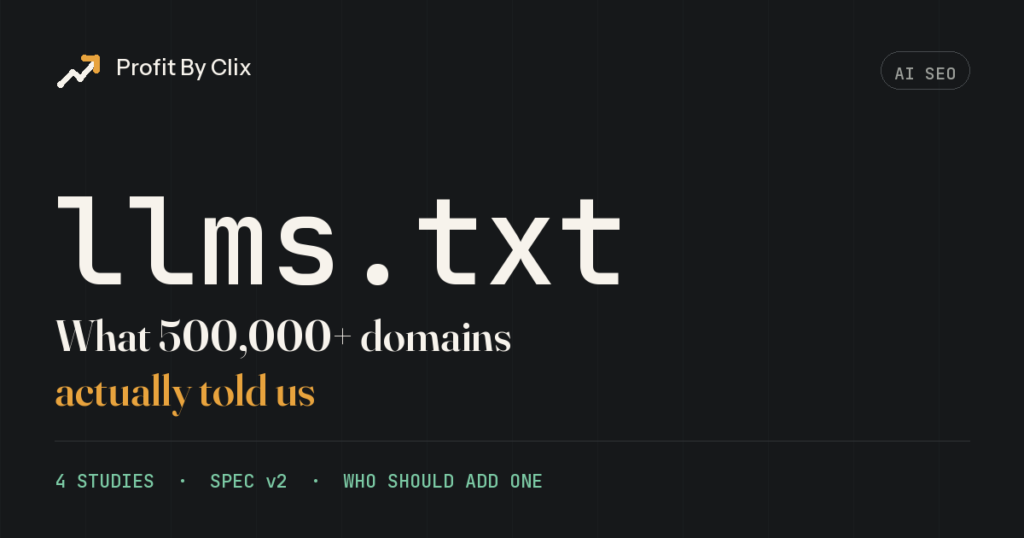
llms.txt Explained: Should Your Brand Add One for AI Crawlers in 2026?
As AI crawlers reshape how people find information, llms.txt has become one of the most confidently recommended tactics in marketing — and…
Read more →Talk to us
Tell us what you want to grow.
Send this and you will get a free audit of your Google rankings and your AI visibility, plus the three fixes we would make first — within 48 hours. No obligation, and you keep the audit either way.