Case study · Sports & Fitness · SEO
90% of traffic was people who already knew them. We built the other 90%.
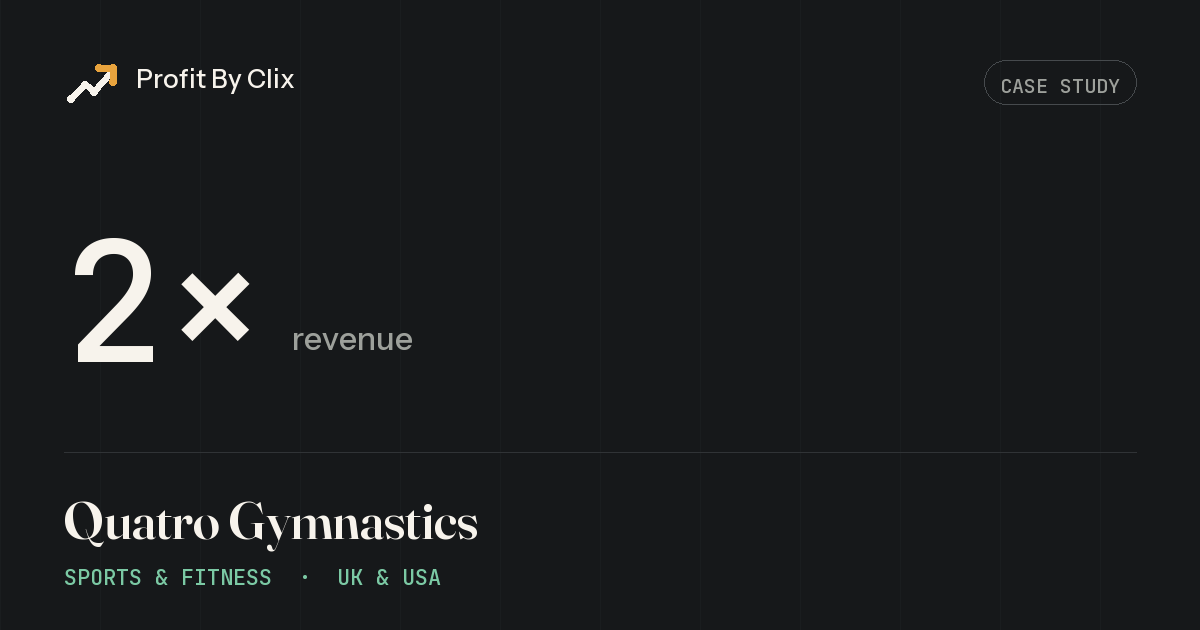
Quatro Gymnastics runs children’s and adult programmes across multiple locations in the UK and USA. Their organic traffic looked healthy — until you noticed almost all of it was people typing ‘Quatro Gymnastics’ into Google. Search brought in almost no one who didn’t already know the brand. Twelve months later, revenue had doubled.
2×
revenue
85%
sessions now non-branded
4 → 89
page-1 keywords
+210%
monthly organic sessions
The problem: branded traffic dependency
This is one of the most underdiagnosed problems in SEO: a business sees organic traffic and assumes its SEO works. Quatro’s non-branded acquisition was near zero. On top of that, mobile pages took 7+ seconds to load, location pages were identical templates with swapped city names, 47 internal links were broken, and the domain had virtually no external authority.
What we did
Months 1–2 — technical foundation
- Cut mobile load time from 7+ seconds to under 2.5
- Fixed 47 broken internal links and resolved duplicate content with canonicals
- Rebuilt every location page with genuinely distinct, geo-specific content
Months 2–6 — content strategy
- Identified 140+ rankable non-branded keywords across class-intent, informational, and comparison searches
- Built three content clusters — recreational, competitive, and adult classes — each with a pillar page and supporting articles
- Reframed everything around how parents actually search
Months 3–12 — authority
- Editorial links from fitness publications and parenting sites
- Partnerships with local schools, youth sports organisations, and community centres
Results after twelve months
| Metric | Before | After |
|---|---|---|
| Non-branded share of organic sessions | under 10% | 85% |
| Page-1 non-branded keywords | 4 | 89 |
| Monthly organic sessions | baseline | +210% |
| Search visibility | baseline | +43% |
| Revenue | baseline | 2× |
| Organic as acquisition channel | minimal | primary |
The takeaway
If your organic traffic is mostly people searching your name, you don’t have an SEO channel — you have a signpost. Building the non-branded side takes technical credibility, content that matches real search intent, and patience. It’s also where the growth lives.
How much of your traffic already knew you?
The free audit splits your branded and non-branded traffic and shows the keywords you could actually win.
Google reviews
What clients say on Google.
From the blog
Notes from the front of search.
What we are seeing in client accounts, and what changed in Google and the AI engines this month.
Google August 2026 Spam Update: What Changed and What to Do Now
Google’s third spam update of 2026 is done rolling out. There are no new policies in it — the same rules as…
Read more →
AI SEO for Indian Businesses: The Complete 2026 Guide
Something strange is happening in a lot of Indian marketing dashboards right now. Rankings are stable, impressions are flat or up, and…
Read more →
llms.txt Explained: Should Your Brand Add One for AI Crawlers in 2026?
As AI crawlers reshape how people find information, llms.txt has become one of the most confidently recommended tactics in marketing — and…
Read more →Talk to us
Tell us what you want to grow.
Send this and you will get a free audit of your Google rankings and your AI visibility, plus the three fixes we would make first — within 48 hours. No obligation, and you keep the audit either way.